Journal Club: Criticality Hypothesis in Schooling Fish
I was in charge of presenting a paper at our lab journal club. The paper I chose was this one [1].
![The paper I presented [1].](/blog/2605211/Lin2025.png)
This paper was recently published by Guy Theraulaz’s group, where I am planning to stay starting around this autumn. It approaches the criticality hypothesis through laboratory experiments on fish schools. I decided to summarize it here partly as a personal memo.
The criticality hypothesis proposes that biological systems operate near criticality in order to simultaneously achieve both plasticity/responsiveness and robustness. In phase space, the boundary separating different phases is called a critical surface. For example, in the case of water, the temperature (0^circmathrm{C}), which separates the solid and liquid phases, is a critical point (a point because the boundary is one-dimensional). At criticality, characteristic phenomena known as critical phenomena emerge, and it has been suggested that living systems exploit these properties. A review paper by Miguel A. Muñoz [2] provides an excellent overview of biological criticality.
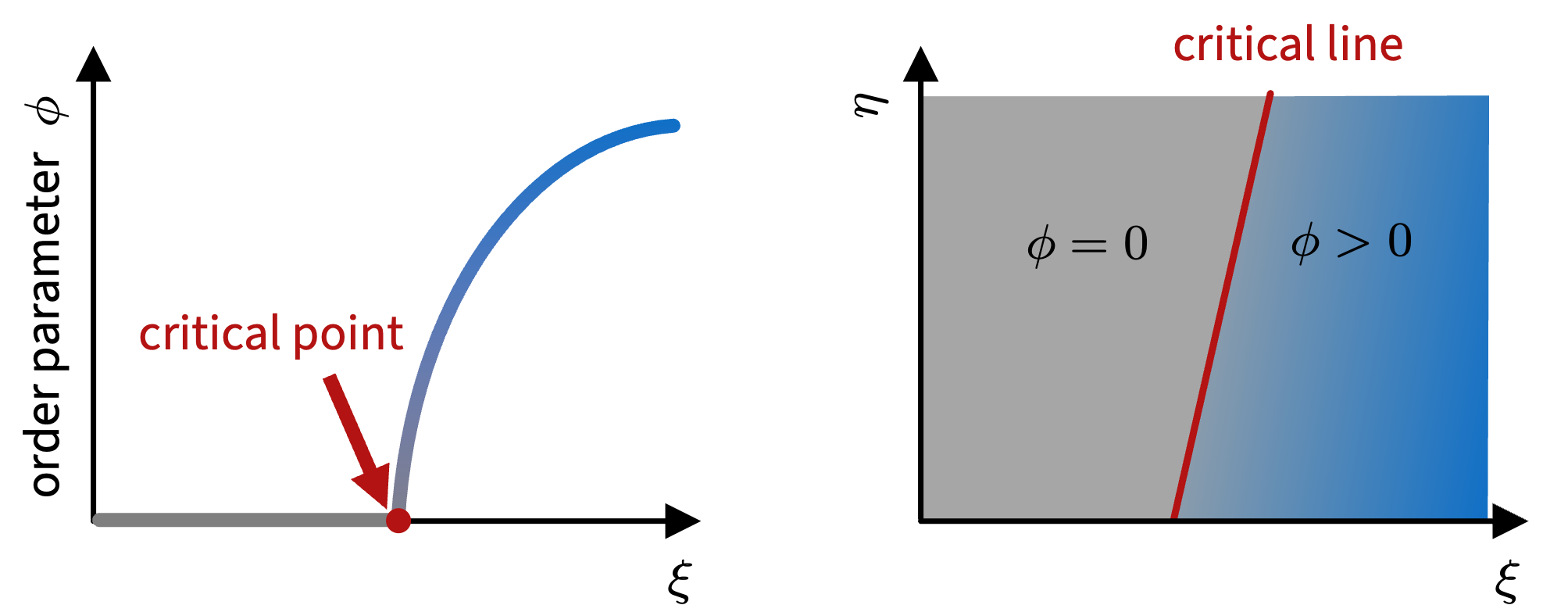
For example, velocity correlations within animal groups sometimes follow a power law, meaning that long-range correlations emerge. Since a power law lacks a characteristic length scale, the correlation length grows with group size, leading to what is called scale-free correlation. This has been reported in starling flocks [3] and midge swarms [4].
Most previous studies testing the criticality hypothesis relied on showing experimentally observed signatures associated with critical phenomena, such as scale-free correlations. However, whether these signatures genuinely originate from criticality itself has remained unclear.
In the paper introduced here [1], the authors construct a phase diagram using a data-driven model of fish schools and show that the actual state of fish schools lies on a critical line in the phase diagram. More specifically, they imposed optical stress on fish by switching environmental light on and off, and reported that:
- under normal conditions, the fish are not in a critical state, whereas under optical stress they become critical,
- for small schools (around 10 fish), the insufficient group size itself acts as a stressor, causing the schools to remain near the critical line regardless of optical stress.
.](/blog/2605211/rummy-nose-tetra_wikipedia.jpg)
I also want to leave some notes on points that caught my attention while reading the paper.
- I am not fully convinced that the critical line is drawn correctly. In Figs. 5 and 6, the paper states that the critical line was determined from local maxima of fluctuations in the order parameter. It does appear to correspond to local maxima when slicing vertically, but not when slicing horizontally. In practice, I think one should compute the Hessian and identify ridge lines instead.
- The paper also assumes, based on the fluctuation–dissipation relation, that maximum order fluctuations correspond to maximum responsiveness, but I am not fully convinced. The authors cite another paper of theirs [5], where they apparently derive a fluctuation–dissipation relation for the coast-and-burst model they use. Unfortunately, I could not read it because our university does not subscribe to the journal.
More broadly, I still do not fully understand the criticality hypothesis itself. In ordinary statistical physics, when discussing criticality, phase boundaries become sharp in the thermodynamic limit: below some threshold , while above it . In animal groups, however, finite group size prevents such sharp phase boundaries from emerging. I still do not understand critical phenomena well in such finite systems, so if anyone knows more about this, I would be very interested to hear.
That said, I think the criticality hypothesis is a fascinating idea with the potential to explain many aspects of living systems. I am excited to see how this field develops. Also, during my stay in France, I will probably work with the same fish species and models used in this paper, which I am also looking forward to. Anyway, that was my paper presentation.
References
[1] G. Lin, R. Escobedo, X. Li, T. Xue, Z. Han, C. Sire, V. Guttal and G. Theraulaz, “Experimental Evidence of Stress-Induced Critical State in Schooling Fish”, PRX Life 3, 033018 (2025). https://doi.org/10.1103/nr7p-m4ff
[2] M. A. Muñoz, “Colloquium: Criticality and dynamical scaling in living systems”, Rev. Mod. Phys. 90, 031001 (2018). https://doi.org/10.1103/RevModPhys.90.031001
[3] W. Bialek, A. Cavagna, I. Giardina, T. Mora, O. Pohl, E. Silvestri, M. Viale and A. M. Walczak, “Social interactions dominate speed control in poising natural flocks near criticality”, PNAS 111, 7212–7217 (2014). https://doi.org/10.1073/pnas.1324045111
[4] A. Attanasi, “Finite-Size Scaling as a Way to Probe Near-Criticality in Natural Swarms”, Phys. Rev. Lett. 113, 238102 (2014). https://doi.org/10.1103/PhysRevLett.113.238102
[5] D. S. Calovi, U. Lopez, P. Schuhmacher, H. Chaté, C. Sire and G. Theraulaz, “Collective response to perturbations in a data-driven fish school model”, J. R. Soc. Interface 12, 20141362 (2015). https://doi.org/10.1098/rsif.2014.1362